Wednesday, February 2, 2011

Change afoot, but why?

I've been a bit remiss of late as to when I post here. It used to be every Sunday, but one way or another change is upon me.

I seldom talk here about my work, but it seems appropriate today to mention that recently I've steered away from the full-on IT support I've assisted businesses with for about 12 years, and increased the time I spend on developing web sites, thus honouring my creative side.

Web site design and development has been the side-line theme for those many years, so it's not been hard to up the anti. In fact it's been a delight!

Part of it has involved building a sort of show case or two though. But more than that, test-beds as well. Although I don't have to excuse my lateness re. my blog, there has been resistance caused by simply many hours here designing and then publishing - even right down to a shopping cart [what to sell in it!?].

My main front door: http://www.icommunicate.co.nz
#alttext#

And the photo side: http://www.icommunicate.co.nz/photos/
#alttext#

... where you'll see many of these blog postings repeated [my mantra: type it only once I reckon, and use many times].

But I'm left with one very interesting thought: where is all this heading? You see I'm driven from the heart on all this, and it feels right.

Any thoughts you have would be very welcome thanks!

It's said the pen is mightier than the sword, and that a picture is worth a thousand words!

So folks on closing I only have one recent landscape photo for posting today:

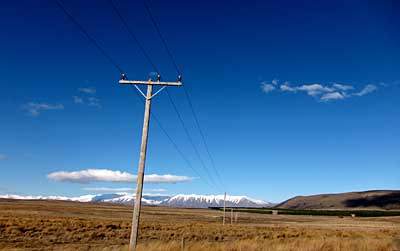
Lindis Pass view of Old Man Peak - made about a week ago...
#alttext#


Labels: , ,

Share |

Monday, October 11, 2010

North and South Mackenzie Country New Zealand - some contrasts, some environmental dilemmas

My son Dougal has always been keen on science, and with Uni. looming next year, I had the idea these recent school holidays to visit the Mt John astronomy observatory at Lake Tekapo in the northern Mackenzie country, so he could see first hand what goes on at this University of Canterbury outpost.

Before our "appointment" with manager Alan we left the beaten track the day before to spend the night in the seldom visited area encompassing Mt Cook Station. The trip and locality give a unique experience that is very different to the normal approach road to Mt Cook National Park. Essentially the route leaves Tekapo and heads overland to Lake Pukaki.

Enroute to Mt Cook Station...
braemar-power-pole-1.jpg

En-route to Mt Cook Station still - Braemar Dome. I've always fancied skiing these gentle big slopes, but access ain't easy..
braemar-2.jpg

Mt Sefton on the left and Mt Cook on the right. Our companions for our camp out in the truck just beside the wild and cold Tasman River. However the Dept. of Conservation seems to be doing a wonderful job here, as many banded dotterel actually wandered around the truck - curious I guess. How wonderful to witness this as they're an endangered species...
sefton-cook-3.jpg

A nesting banded dotterel shot I made a year or two ago, while helping DOC on a braided river bird survey...
banded-dotterel.jpg

Heading back to Tekapo we were witness to some impressive stock handling and dogs...
braemar-sheep-4.jpg

And we met John the grader driver. He'd got his 18 ton machine bogged. While I had no hope of pulling him out with a 2.5 ton Land Cruiser, his colleague nearby in another grader did so in short order. John has spent 27 years, summer and winter keeping all Mackenzie Country secondary roads clear and in order...
braemar-john-grader-5.jpg

Our NZ military use a great swathe of land to practice on. It says what they leave lying around could kill you...
braemar-warning-6.jpg

close-up-warning.jpg

It seems a real shame they've laid claim many years ago to what is a fragile environment then driven and shelled hell out of the place, leaving wounds in the landscape that may never heal...
braemar-military-ruts-7.jpg

Mt John Observatory...
mt-john-8.jpg

Alan gave a fascinating and insightful tour. Here Dougal inspects the new 1.8 meter [mirror] telescope. What Alan, his wife, team, and University of Canterbury astronomers are doing there is very inspirational [see link below]...
1.8m-telescope-9.jpg

So what are some of the contrasts and dilemmas?
The Mackenzie is just one of many unique areas in this compact country, but I know it quite well - I used to live there, so did my grandfather who was a musterer, fencer and shearer.

Lately it's increasingly been coming to the forefront of news. I think people are noticing the unique landscape more, maybe because quite recently it's been changing due to new intensive farming styles. Many want it back how it was, but for this we sadly have to go back much more than several years.

But times are a changing and just last week the head of the Department Conservation (DOC) was calling for urgent and "radical" change in a refreshingly honest presentation [see link below].

Anyway this is some of what I've seen and figured out [with massive thanks to many conservationists, soil conservators, Dept. of Conservation staff, farmers, visionaries, historians, restoration ecologists, and friends - you know who you are!]...

The Tekapo area is actually quite high altitude - cold and windy. But the southern Mackenzie is a bit more user friendly. Trouble is it's all suffered degradation from the late 19th century onwards, when it was all apparently waist deep in snow and red tussock. I should imagine moa would have roamed there a long time ago.

But for most of my life time vast areas have looked like this...
benmore.jpg

Hieracium infestation seems to kill off snow tussock and most other grasses. It's very invasive in some areas - rabbits have been part of it. It's only saving grace is it looks pretty in Nov. each year, but stock cannot eat it. Note the Twizel township and Twizel and Fraser rivers in background...
hieracium.jpg

Down by the Twizel and Fraser rivers it becomes evident that irrigation totally changes the eco system, just like hieracium and rabbit infestation. However in this instance the irrigation is more natural and much less energy dependent - this is probably reclaimed wetland, point being that the grasses are deep rooted and not superficial, therefore more able to cope with the extremes of climate typical of the area, and maintain old time habitats...
ruataniwha.jpg

And the hand of man also changed the scenario in yet another way in the 1970s, with a series of canals and power stations. The project developers did an amazing job under budget always [politicians kept at bay so there was minimal ego informed bungling], and gave us an asset that actually [unlike the Clutha's Clyde dam debacle], produces a lot of energy. But there was a cost, despite their mandate to leave the land better then they found it: We lost wetlands, wild rivers and even a gorge so wild and remote few know about it, for back then these features were not seen as assets...
ohau-b.jpg

Old time locals have been pushed into smaller areas. And what they live on has been altered by all scenarios so far mentioned. It seems minor, but that green blur is a "wilding" pine tree. Yet another highly invasive weed in NZ's high country, that is especially a huge almost incomprehensible problem down-wind from the above mentioned Mt Cook area...
falcon.jpg

So just as maybe a hundred years ago, the landscape is changing yet again! Now we have the New Zealand version of crop circles, but in our case there is no mystery or aliens - they're called pivot irrigators...
pivot-circle.jpg

So we have two extremes down on the flats in this photo looking towards Lake Ohau, and neither are favorable hosts to the native snow or red tussock, and all the bugs and birdlife that can live with them...
ohau-irrigation.jpg

The latest mooted change in the southern Mackenzie, is diary cattle will have huge sheds to live in - so called cubicle farming. These plans of a few farmers are causing quite a fuss right now, with claims this will improve things, and counter claims from conservationists, [who in some instances perhaps think the status quo of 2-3 years ago is desirable]. The intensive farming lobby argue that they're stopping the scarce soil from eroding away, and actually creating new, but seemingly almost as an aside, water quality issues compromised by effluent get glossed over.

But all this irrigation is actually making even more changes to the eco systems - those places where numerous bugs live. Many are rare apparently.
I might be more impressed if their grasses and techniques could survive drought - in other words be less dependent on technology [it often costs a lot to pump water to irrigators]. I don't seem to see enough evidence of sound dry-land farming techniques that have been impressively employed by the established fine wool farmers for many years. And, yes, rabbits don't like it green, but neither will snow tussock establish easily [once mature/established, they're more tolerant]. Sadly I see few attempts to establish corners, corridors or shelter belts comprised of these natives, and others.

So for our children and future generations, how do we get back more areas to something approximating this scene...?
bindu.jpg

As I drove back home over the Lindis Pass, a reserve of snow tussock, yet again, just as I've noted for years, they're just surviving and not really recovering at all to waist deep status...
lindis-tussock-10.jpg
Restoration ecology is a huge challenge in the Mackenzie because of the scale, but one we could easily win at with cooperation, less greed and more education.

More treasuring what we've been gifted by nature would help, as would more acknowledgement that there are many old time farmers who've achieved great insights and land management skills, and a Dept. of Conservation that is staffed at ground level by people with a passion for their work, and now headed by a manager who sees things with a big picture in mind, and is not afraid to speak out.

We have more resources than we think!

It's all about perception! We need to lift our awareness that we are the land, and not stuff it all up - then we'll all be healthier in mind and body.

Links:
NZ "trashing our environment" - Dept. of Conservation chief speaks out
Dept. of Conservation's efforts in the Twizel area
Mt John observatory
Mackenzie Guardians...
Forest and Bird's Save our Mackenzie Country

It does not seem to help that either end of the Mackenzie is administered by different Councils. Environment Canterbury and Waitaki

Labels: , , , , , , , , , , , ,

Share |

Monday, October 26, 2009

Dunstan Mountains sojourn

I worked for at least half of this NZ Labour Day long weekend, but on Sunday evening my good friend Roger and myself headed up to about 1200 meters on the nearby Dunstan Mountains for an overnight stay in my Land Cruiser camper truck. The theme was landscape photography - we've done these trips before and find them really fun, and also both being photographers we're tolerant of each other's time needs.

The light turned out to be flat where we camped, and so we had a little of this sort of light in the sky, but sadly nothing on the ground...
dunstan-1.jpg

dunstan-2.jpg

A sunrise lacking any direct light did little for me so unlike Roger, who was up and working with his wide format cameras, I slept in then took a walk while he went back to bed. I left a broad ridge and dropped into this lovely gully to descend from my high point not far from patches of snow...
dunstan-3.jpg

It's a big landscape when given scale by my camper...
dunstan-4.jpg

Roger has a new puppy and she's quite proud of having stalked and captured an earthworm for breakfast...
dunstan-5.jpg

I was fascinated by this low cloud coming in, obviously preceding very nasty weather. Our 4wd track was medium steep with patches of soil that would be tricky in the wet, so I was watching this phenomena with more than a passing interest knowing the only way home was down...
dunstan-6.jpg

The only panorama shot I was happy with - like I said with flat light, to my mind we really only practised...
dunstan-7.jpg

Once down from the tricky heights and just before the front caught us, we checked out an old gold mine I know of nearby...
dunstan-8.jpg

Below the mine shaft there is a restored stamper battery...
dunstan-9.jpg

While Roger made lots of photos I explored, and during such times in these places I ponder what it would have been like sans shade and shelter from the wind such as this apple tree now provides...
dunstan-10.jpg

Of course there is lots of water right now in spring to help the sluicing for gold, but what must the scene have looked like without these recent willows, and what would the sounds have been like of people madly working to process as much rock as possible before summer arrived and the little streams became almost dry. Of course in winter in such shady places they'd be frozen. Central Otago is a land of extremes!
dunstan-11.jpg

Returning I made this photo of Roger working, literally just catching his eye with only seconds of warning - anticipation is one of the keys to an interesting portrait...
dunstan-12.jpg

Lastly just as the rain started, giving this Californian poppy no chance to open for business we just had to stop again as the colour is compelling, and with a backdrop of the Lindis Valley, one more picture had to be made...
dunstan-13.jpg

Roger's photography website ... more>>

Labels: , , ,

Share |

Sunday, March 22, 2009

An eclectic mix: musings, landscape photography, vineyards, life in Wanaka, history and my new iPhone

Last weekend was Wanaka Show weekend. For those of you non New Zealand readers a "Show Day" is a fair day held annually in the various provinces on different dates, and is a couple of days usually where town meets country. Livestock is judged, there are horse events [many go from show to show following them around the country], trade exhibits, pet parades [how I loved taking my son to these with the pet of the moment, puppies, guinea pigs etc], children's art shows, photography, baking, preserves, vegetables, all with modest prizes for all winners. It's pretty cool and the history is rich, but perhaps the most interesting thing is it's not rained on the Wanaka Show in about 50 years, and on schedule this year, bingo, the weather settled at last into chilly airs and stunning sunshine with no wind. And so the legend continues!

Dougal and Badger, the former looking pleased with his prize certificate, while Badger's attention is on the other dogs nearby! A copy from a photo that appeared in the local paper back in March 2004...
show-day2.jpg

My good friend Roger was in town for the Sunday after doing a photo shoot in Fiordland, so we decided to have an evening out making photos in the Bendigo area in the Dunstan Mts., only 30 mins. drive from home, and rich with gold mining history.

On the lower slopes there are now many sunny slightly elevated areas planted in grapes, and the bird netting makes for some interesting variations on landscape photography...
show-day3.jpg

Laying it out must be quite a job, and even more so rolling it up again...
show-day4.jpg

show-day6.jpg

But there is plenty of landscape left in it's more undeveloped state - looking north here from the site of the historic gold mining town of Welsh Town, up the lower Lindis valley...
show-day5.jpg

Higher up is Logan Town, which is the more commonly visited and photographed area. I took this series of shots back in 2007...
show-day7.jpg

show-day8.jpg

show-day9.jpg

And during the week I finally bought an iPhone. OK mainly for work, but the gadget kid in me is having a great time. I'll be posting about it for weeks in my work blog I think, and already I've found it's camera useful.

Lastly this week's blog recommendation is Robb Kloss's Musings from Aotearoa. Great writing illustrated with photos and a strong flavour of family and the Ruahine Range in the North Island, with attention to environmental issues. Thanks Robb

Labels: , , , , , , , , , , , , , , , , , ,

Share |